
Speech therapy data tracking
Speech therapy data tracking for school SLPs
Track trials for one student or a group, keep every student's goal records separate, and record actual prompting. Saved sessions supply the goal graphs and progress paragraphs you review and edit.
14-day tracking and report-writing trial, no card. Activity Studio requires a paid plan for new accounts. Subscribe for $24/month or $240/year; paid checkout charges immediately.
How it works
Add a student and paste an existing goal
Start tracking opens the existing Live Session workflow after sign-in. Add a student and paste your clinician-reviewed IEP goal; you do not need to set up the whole caseload first.
Record trials and actual support
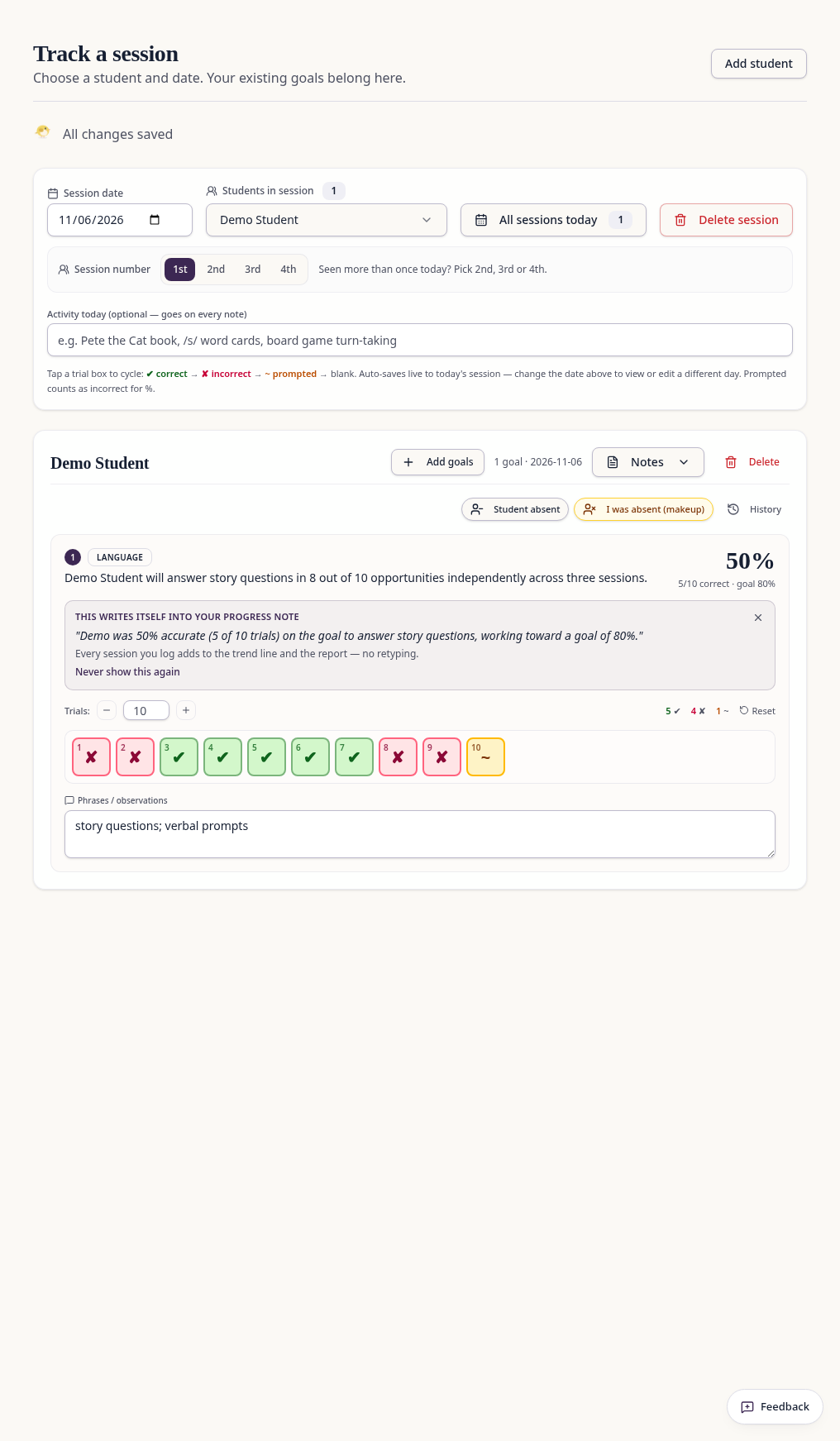
Select a student or saved group. Each student keeps separate goal rows and trial records. Cycle trial boxes through correct, incorrect, prompted and blank, and describe the real prompt type in observations when needed. Wait for saving to finish before leaving.
Open IEPs & data for the goal graph
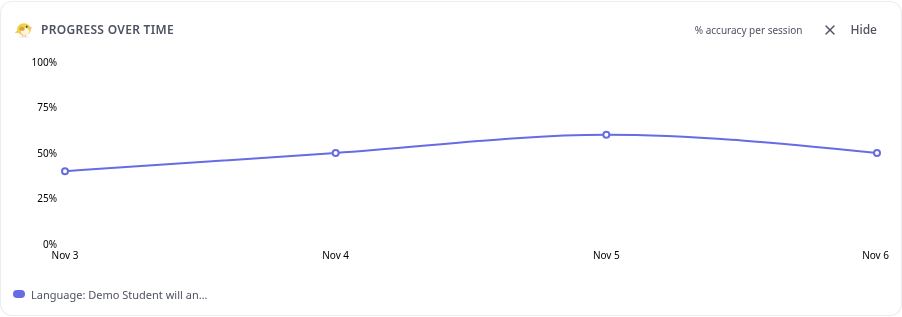
Open that student to see each active goal as a separate line on Progress over time. Counted same-day trials are pooled; blank trials do not count as attempts.
Generate, edit and copy the progress update
Choose Generate under Progress update. Review the present-levels summary and edit the paragraph attached to each goal. Copy or download as text before leaving: this output is not saved as a report document.
How group session data stays separate
This fits school SLPs who take trial-by-trial data for individual students and small groups, need prompted responses kept apart from independent correct responses, and want goal graphs and progress paragraphs drawn from the sessions they saved.
- Separate student and goal records: choose one student or a saved group in Live Session. Each student's trials save against that student's own goal and session date; the group does not become one child's combined accuracy.
- Actual cueing controls: each trial box cycles through correct, incorrect, prompted and blank. Prompted responses stay out of independent correct counts. Record the support you actually gave—such as verbal, visual, gestural or tactile cues—in the observation field; the prompted mark alone does not capture that detail.
- Graph and copyable progress draft: after the session saves, open the student in IEPs & data. Progress over time gives each active goal its own line. Choose Generate under Progress update to review and edit the present-levels summary and each goal paragraph, then copy or download the text. The generated update is not saved as a report document.
What it does not do
- It does not replace your mastery decision. The goal summary can compare recorded performance with the written criterion; pooling counted trials across days shows recorded accuracy. You verify whether a criterion such as a number of consecutive sessions is met from the session-by-session record.
- A progress update is not an evaluation. Evaluation reports use the separate case workspace and testing results.
- No IEP-system or Medicaid billing connection, and no standardized test scoring.
Related: group data collection guide · SLP Draft vs SLP Toolkit · free baseline tally
Inside the tracking workspace
Real SLP Draft interface screenshots with fictional demo data. These were captured in an isolated browser demonstration, not a customer account. The graph shows recorded independent accuracy, not an estimate of unobserved performance.
Sample: from session data to a progress update
Fictional example. "Student J." is an invented student. The goal, dates and counts were made up to show the method. No real student data is used.
Input 1: the IEP goal
Student J. will answer who, what and where questions about a short story read aloud in 8 out of 10 opportunities independently across three consecutive sessions.
Baseline: 4 out of 10 opportunities independently (fictional baseline)
Input 2: recorded sessions
| Date | Independent | Prompted | Incorrect | Indep. % | Met 8/10? |
|---|---|---|---|---|---|
| Sep 8, 2026 | 8 | 1 | 1 | 80% | Yes |
| Sep 15, 2026 | 9 | 0 | 1 | 90% | Yes |
| Sep 22, 2026 | 7 | 2 | 1 | 70% | No |
| Sep 29, 2026 | 9 | 1 | 0 | 90% | Yes |
Activities noted: picture-book retell, story map with visuals.
- Independent responses total 33/40 (83%). Prompted responses stay separate and are not added to the independent numerator.
- The last three sessions were 9/10, 7/10 and 9/10 independently. September 22 interrupts the required three-session run, so the pooled 83% does not establish mastery.
Output: an illustrative draft
Across 4 sessions from Sep 8, 2026 to Sep 29, 2026, Student J. answered who, what and where questions about a short story independently in 33 of 40 opportunities (83%). Including answers given after a prompt, Student J. answered correctly in 37 of 40 opportunities (93%). Prompted answers remain separate from independent correct answers. In the most recent session, Student J. answered independently in 9 of 10 opportunities during a story map with visuals activity. The goal criterion (8 out of 10 opportunities independently across three consecutive sessions) has not yet been met: Sep 22, 2026 was 7 of 10 independently, below the per-session target. Pooled accuracy alone does not establish mastery.
Every number above comes from the table. This shows the kind of update SLP Draft drafts; real drafts vary with your data and wording. After generating, verify the original counts, prompt notes, per-session results and consecutive-session requirement against your records, then edit before copying. A draft is not clinical advice or a clinical decision. Progress updates are not saved as report documents; copy or download the text before leaving.
Read a step-by-step worked example of writing a progress report by hand
Common questions
Related reading and free tools
- Is SLP Draft only a report writer?
- No. SLP Draft is an all-in-one workspace for school SLPs: live data tracking, goal progress, notes, Activity Studio and report drafting. Each uses the existing student or case workflow; you review the output.
- Is this SLP data collection software for school-based SLPs?
- Yes. It supports individual and group trial recording, goal-level graph lines and reviewed progress updates from saved records, without a direct IEP-system or billing connection.
- Can I track individual and group sessions?
- Yes. Select a student or a saved group in Live Session. Each student's trials are stored separately against their own goal and session date; group results are not combined into one child's accuracy.
- How are prompts recorded?
- Trial boxes cycle correct, incorrect, prompted, then blank. Prompted responses are not counted as independent correct responses. Add the prompt type or support you actually provided in the observation field; the trial mark alone does not record a verbal, visual or tactile cue level.
- Can I see graphs for individual goals?
- Yes. Open the student in IEPs & data to see Progress over time. Each active goal has its own line and legend on the student's chart. Same-day counted trials are pooled; empty, unattempted trials are excluded. Older percent-only records cannot provide original trial counts.
- How do saved sessions become an editable progress update?
- Wait for the live session to finish saving, then open that student in IEPs & data and choose Generate in Progress update. Review the present-levels summary and edit each goal's progress paragraph. Counts and criteria come from the recorded goal data; only recorded notes can support activity or prompt descriptions. Copy or download each goal's update as text.
- Is the progress update saved as a report document?
- No. The generated tracking progress update and your paragraph edits are not saved as a document. Copy or download the text before leaving. Saved session data stays available. Evaluation report drafts use the separate case workspace, where sections are saved and export to Word.
- What are the limits?
- This is not standardized testing, a diagnosis, an eligibility decision or a direct IEP-system or Medicaid billing integration. Sparse data may be insufficient for a trend or goal criterion. Check every draft against your actual records; no unrecorded skills, prompts or improvement should be inferred. Use only information your district permits; initials alone do not guarantee de-identification.
Not ready yet? Get the free SLP toolkit by email.
Try it with your next session.
Try IEP goal and session data tracking, progress monitoring, and report drafts for 14 days. Activity Studio requires a paid plan for new accounts.