
The Language Sample That Actually Holds Up at the IEP Table
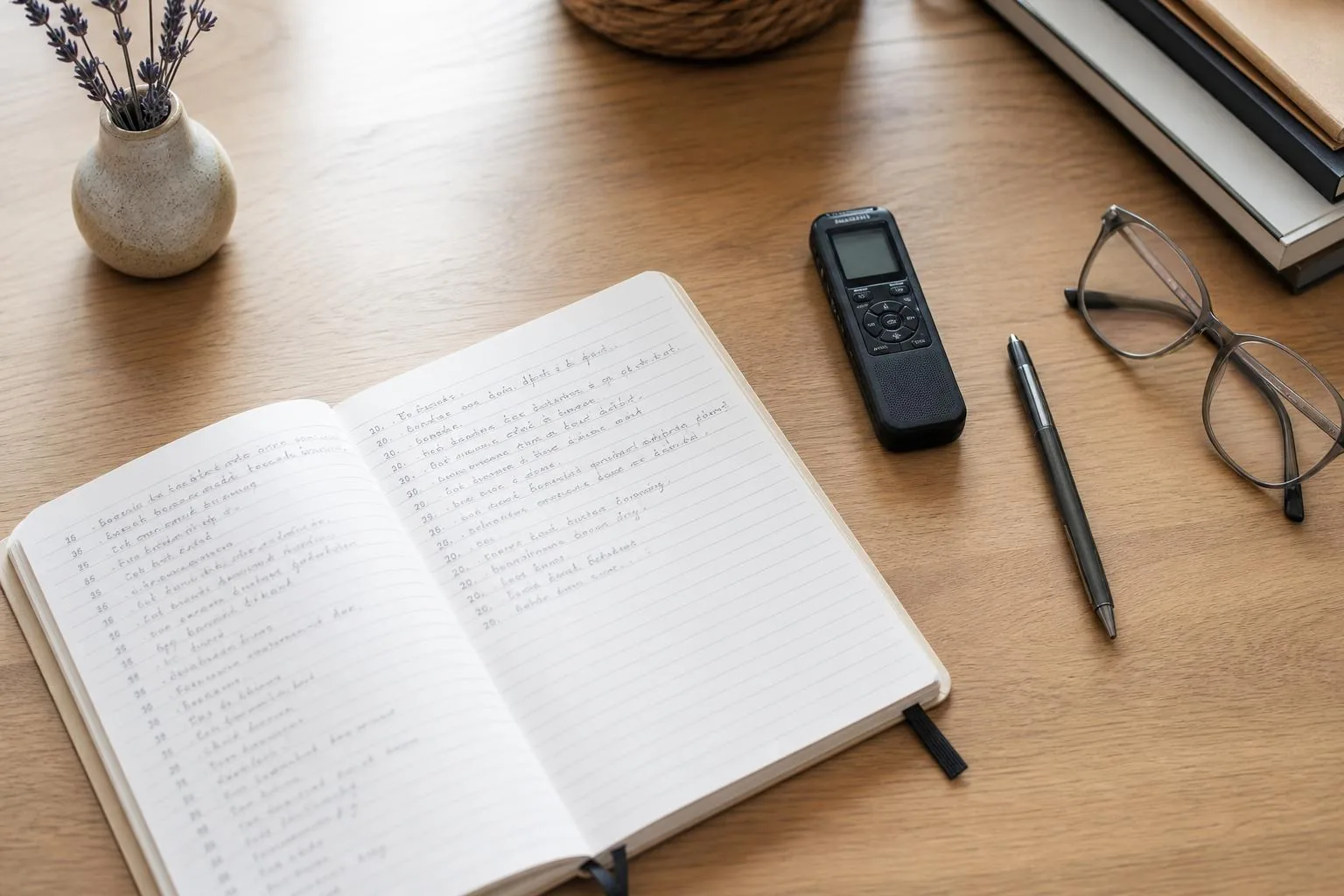
A standardized test gives me a number. A language sample tells me what a kid can actually do with language when nobody is timing them. For most of the evaluations I write, the language sample is the most clinically rich — and most defensible — part of the whole report.
It's also the part I see other SLPs cut corners on most often, because it takes time. Here's the workflow I've landed on after years of doing this on Friday afternoons in a borrowed conference room.
When I always take a sample
Best practice — and in a lot of districts, the eligibility criteria — calls for a language sample whenever:
- Standardized scores fall in a borderline range and I need converging evidence.
- The student is bilingual or from a linguistically diverse background.
- Concerns are mostly expressive, pragmatic, or narrative.
- I have a hunch the standardized tools are underselling the kid — attention, behavior, the testing format.
Getting a sample you can actually use
Aim for 50 to 100 complete, intelligible utterances. Quality beats length every time — a 50-utterance sample of spontaneous, varied speech is more useful than 100 utterances of yeah and idk.
- Open-ended prompts. Wordless picture books, story retells, conversations about something that just happened, describing a busy scene.
- Avoid closed questions. "Tell me what's happening here" pulls connected speech. "Is the boy running?" gets you yes.
- Record audio when you can. Real-time transcription will miss the morpheme-level detail that matters for MLU. I learned this the hard way.
- Write down the context. Task, materials, the prompts I gave, anything behavioral. All of it matters when I sit down to interpret.
What I actually look at
A defensible language sample analysis is more than MLU. I look at several dimensions:
- MLU in morphemes — average utterance length, computed deterministically. (I wrote up the rules I use for MLU here.)
- Type-token ratio (TTR) — lexical diversity. Different words divided by total words.
- Syntactic structures — complex sentences, conjunctions, subordinate clauses, the range of verb forms.
- Grammatical errors — how often and what kind: past tense, irregulars, articles, pronouns, copulas.
- Narrative structure — for retells or generations: setting, characters, initiating event, internal response, plan, attempt, consequence, resolution.
- Pragmatic features — turn-taking, topic maintenance, repair strategies, perspective-taking.
Writing it up
The language sample section connects the numbers to the narrative. Every write-up of mine includes:
- The context — what task, with whom, how long, how many utterances.
- Quantitative measures — MLU, TTR, any other counts, with a quick comparison to age expectations.
- Qualitative description — sentence types, errors I observed, narrative structure, pragmatic notes.
- Three to five direct quotes from the transcript that illustrate the patterns.
- Clinical impression — what the sample suggests about this kid's expressive language in real, functional contexts.
That last one is the part nobody teaches you to write. It's also the part the IEP team will actually read.
Sources
- • ASHA Practice Portal — Language In Brief (MLU, TTR, narrative & pragmatic measures).
- • Miller, J. F., & Iglesias, A. — SALT Software: sample length, transcription & analysis conventions.
- • Heilmann, J., Nockerts, A., & Miller, J. F. (2010). Language sampling: Does the length of the transcript matter? LSHSS, 41(4), 393–404. ASHA Journals
- • Paul, R., Norbury, C., & Gosse, C. (2018). Language Disorders from Infancy through Adolescence (5th ed.). Elsevier — language sample analysis chapter.
- • Brown, R. (1973). A First Language: The Early Stages. Harvard University Press.
A faster way to build the section
SLP Draft turns a typed or pasted transcript into a structured language sample section. MLU is computed deterministically, utterances are editable per line, and you get a draft narrative you can review and refine before it lands in the report. The clinical judgment stays yours.